Rhythms Over Checklists: Creating a Home with Room to Breathe
For years, I believed the problem was that I simply wasn’t organized enough.
I bought planners.
I made checklists.
I wrote schedules.
I tried to “manage my time better.”
And for a little while, those things would help.
Until life happened.
Someone got sick.
Work became overwhelming.
Pain flared up.
The children needed more from me.
I became exhausted and ignored it until I couldn’t anymore.
Then suddenly, all those unfinished lists felt like proof that I was failing.
Over time, I’ve realized that many of us are trying to force ourselves to live like machines instead of human beings.
Modern life pushes us toward constant productivity. We are surrounded by messages telling us to optimize everything:
- our homes
- our schedules
- our meals
- our routines
- our hobbies
- even our rest
But real life doesn’t move in straight lines.
It moves in rhythms.
And I think somewhere along the way, we forgot the value of that.
When I watch older homemaking videos and read about the daily rhythms many families once followed, I notice something very different from today’s culture. Those homes were not perfect. The people living in them were not endlessly productive. But many homes had a natural flow built into the day.
There was time for:
- preparing meals
- tidying up
- sitting down for coffee
- visiting neighbors
- resting for a moment
- working with the seasons instead of against them
People weren’t expected to be reachable every second of the day. Homes weren’t constantly interrupted by notifications, emails, social media, and the pressure to always be “on.”
There was space.
Not empty space.
Living space.
Breathing room.
And honestly, I think many of us are starving for that now.
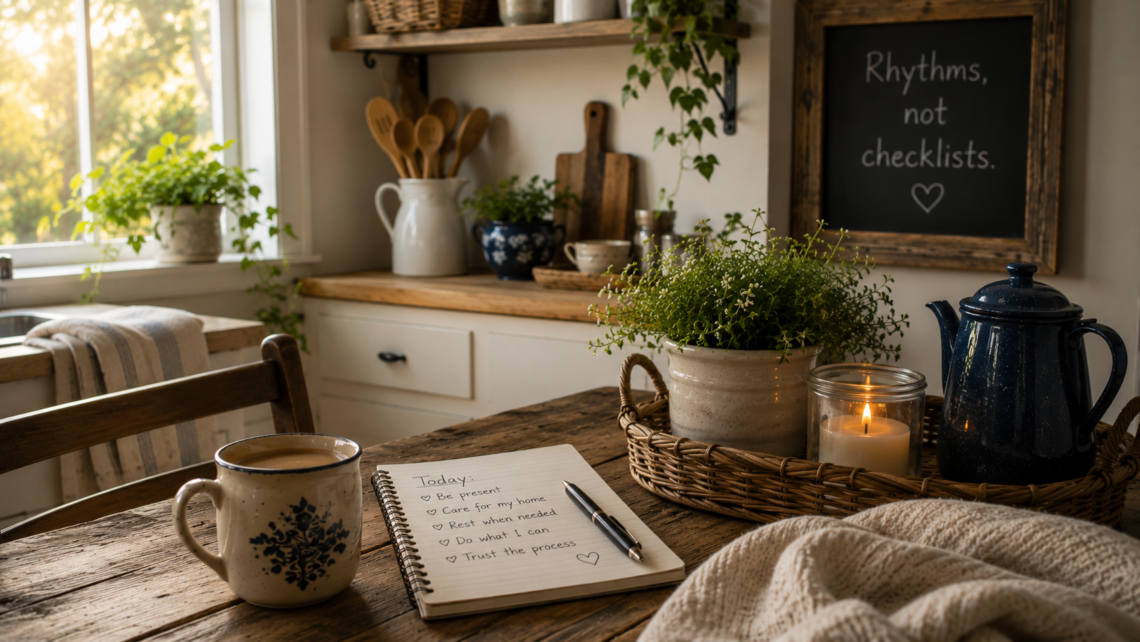
These days, I try to think less in terms of rigid checklists and more in terms of gentle rhythms.
Instead of:
“Everything must be finished.”
I think:
“What would help my home feel cared for today?”
That shift has changed so much for me.
Some days, the rhythm is:
- unload the dishwasher
- wipe the counters
- start a load of laundry
- sit down with coffee afterward
Other days, the rhythm might simply be:
- water the plants
- prepare dinner early
- rest when my body says it’s time
And yes, sometimes the rhythm includes doing nothing productive at all.
As someone who lives with chronic pain and fatigue, learning to notice tiredness instead of pushing through it has been incredibly important. For years, I treated exhaustion as something to ignore until I completely crashed. Now I’m slowly learning that rest is not laziness. Pausing is not failure.
The beautiful thing about rhythms is that they leave room for real life.
They allow for:
- children
- interruptions
- illness
- changing seasons
- low-energy days
- spontaneous visits
- slow mornings
- unfinished tasks
Rhythms acknowledge that homes are lived in by human beings, not managed like factories.
And maybe that’s part of what so many people are longing for right now—not perfect routines, but gentler ways of living.
A slower pace.
A little margin.
A warm drink without guilt.
A home that feels peaceful instead of pressured.
I think many meaningful things can still be accomplished in five or ten minutes at a time. A few dishes washed. A loaf of bread mixed. A basket folded. A garden watered. Small things matter.
Especially when they are done with care instead of exhaustion.
That’s the kind of life I hope to cultivate here at A Small Batch Home.
Not perfect rhythms.
Just meaningful ones.