When More Income Doesn’t Create More Financial Freedom
For decades, many families have been told that the answer to financial stress is simple: earn more money.
Work more hours, add another income stream, start a side hustle, pick up overtime, or find ways to increase household income.
But in the pursuit of financial stability, many people never stop to ask an important question:
What is the true cost of maintaining that lifestyle?
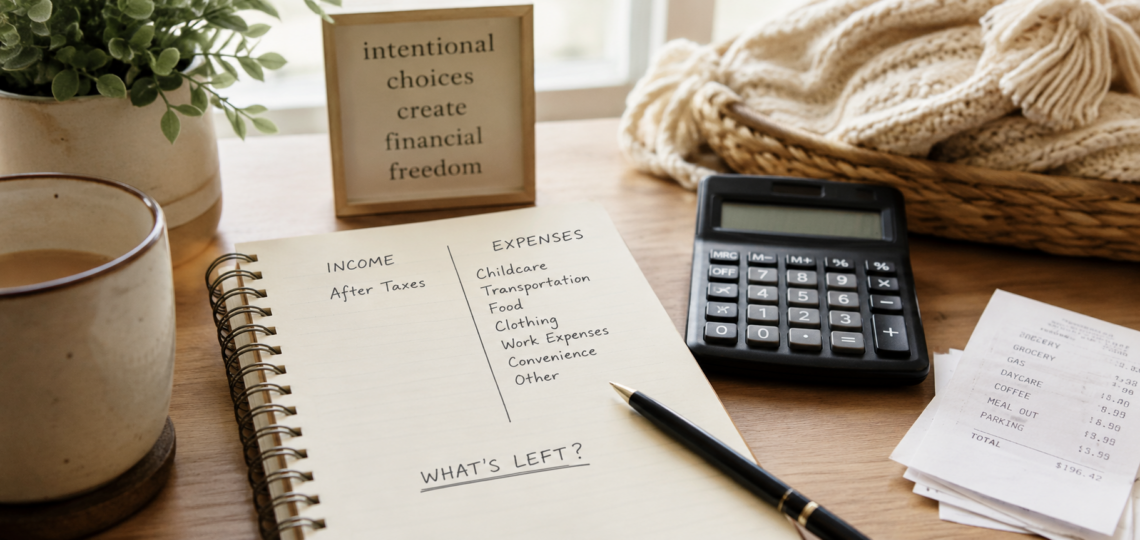
Between childcare, commuting expenses, convenience meals, workplace spending, and the pressure of constantly trying to keep up with modern life, some families may discover that simplifying life and reducing expenses creates more financial breathing room than increasing income alone.
And while increasing income can absolutely help in some situations, many households never stop to calculate the actual cost of maintaining that extra income.
Sometimes the additional paycheck is not nearly as profitable as it appears on paper.
This is not a criticism of working parents or dual-income households. Every family has different needs, goals, personalities, and financial realities. Some households absolutely require two incomes, and many people genuinely enjoy their careers and thrive in them.
But it is worth asking an honest question:
Is the second income truly creating financial margin — or is it mostly sustaining the lifestyle required to maintain it?
The Hidden Costs Many Families Overlook
When people calculate income, they often focus on gross pay while overlooking the secondary expenses attached to working outside the home.
These costs can quietly consume a significant portion of a paycheck.
Childcare
For families with children, childcare is often the largest expense associated with work.
This may include:
- daycare
- after-school care
- summer programs
- babysitters
- registration fees
- transportation
- sick-day coverage
For some households, childcare alone absorbs a large percentage of one parent’s income.
Convenience Food & Takeout
When both parents are exhausted and pressed for time, convenience spending naturally increases.
This often includes:
- takeout meals
- fast food
- drive-thru coffee
- frozen convenience meals
- individually packaged snacks
- meal delivery services
- pre-prepared grocery items
This is not laziness.
It is often survival mode.
But these small convenience purchases add up quickly over time.
Transportation Costs
Working outside the home creates ongoing transportation expenses, which many people mentally separate from employment.
These may include:
- car payments
- fuel
- maintenance
- oil changes
- tires
- tolls
- parking
- increased insurance
- vehicle depreciation
Some households maintain a second vehicle almost entirely because both adults commute.
Clothing & Appearance Expenses
Many jobs require:
- professional clothing
- extra shoes
- handbags or accessories
- cosmetics
- salon visits
- grooming products
- uniforms
- dry cleaning
Even workplaces with relaxed dress codes often create pressure to maintain a certain appearance.
Workplace Spending
There are also many “small” social expenses connected to work:
- lunches out
- coffee runs
- birthday collections
- baby showers
- retirement gifts
- holiday exchanges
- office fundraisers
- after-work gatherings
Individually, these expenses may seem insignificant.
Collectively, they can become substantial.
Paying to Save Time
Busy households often spend money trying to compensate for a lack of time and energy.
This may include:
- grocery delivery
- meal kits
- cleaning services
- lawn care
- subscription services
- convenience appliances
- paid household help
Again, none of these things are inherently wrong.
But they are important to factor into the true financial picture.
The Cost of Exhaustion
One of the hardest costs to measure is burnout.
When life becomes overwhelming, many people spend money simply trying to cope:
- impulse purchases
- emotional shopping
- convenience spending
- entertainment spending
- “treat yourself” purchases
- frequent takeout
Stress itself can become expensive.
The Other Side of the Equation
Many financial conversations focus entirely on increasing income.
But income is only one side of the equation.
The other side includes:
- expenses
- stress
- time
- energy
- home management
- physical capacity
- emotional bandwidth
A household can technically earn more money while simultaneously feeling:
- more rushed
- more exhausted
- more disconnected
- more financially strained
More income does not always create more margin.
Sometimes Simplicity Creates More Breathing Room
For some families, reducing expenses intentionally may create more financial stability than increasing income.
Especially when simplifying helps reduce:
- takeout spending
- childcare costs
- commuting expenses
- impulse purchases
- duplicate buying
- convenience dependence
- clutter and overconsumption
Simple systems at home can have a surprisingly powerful financial impact.
Things like:
- meal planning
- cooking from ingredients
- maintaining a pantry
- organizing household inventory
- reducing consumerism
- buying intentionally
- simplifying routines
…may not seem dramatic, but over time, they can significantly reduce financial pressure.
This Is About Awareness, Not Judgment
Every household is different.
Some families need two incomes.
Some parents love working outside the home.
Some stay-at-home parents are overwhelmed, too.
This conversation is not about guilt or rigid ideals.
It is simply about asking thoughtful questions:
- What is this lifestyle truly costing us?
- What are we gaining?
- What are we sacrificing?
- Is our spending aligned with our values?
- Are we building a life that actually supports our wellbeing?
Sometimes the answer will still be two incomes.
But sometimes families may discover that simplifying life, reducing expenses, and living more intentionally creates more peace than constantly trying to earn more.
And in a culture that constantly pushes us toward bigger, faster, newer, and busier…
that realization can be incredibly freeing.
Want to see what a second income is really bringing home? True Cost of 2nd Income Final to calculate hidden work-related expenses, true take-home pay, and your actual hourly earnings after costs are factored in.