De-Influencing for a Simpler Life
There was a time when people called it “keeping up with the Joneses.”
Now it comes to us through endless scrolling, targeted ads, influencer hauls, aesthetic trends, productivity gadgets, beauty routines, home resets, organization systems, and carefully curated videos designed to make ordinary life feel inadequate.
The message is constant:
- You need this.
- Your home needs this.
- Your children need this.
- Your routine would be better with this.
- Your kitchen would function better with this.
- Your life would finally feel peaceful if you just bought one more thing.
And little by little, many of us end up overwhelmed, overstuffed, overstimulated, and financially strained while still somehow feeling like we don’t quite measure up.
That is not an accident.
Modern consumer culture depends on dissatisfaction.
If people became content with what they had, entire industries would collapse overnight.
The New Version of “Keeping Up with the Joneses”
Years ago, comparison mostly happened within neighborhoods, churches, schools, or social circles.
Now we compare ourselves to millions of people every single day.
We see:
- professionally decorated homes
- elaborate pantries
- massive grocery hauls
- expensive skincare routines
- trendy wardrobes
- color-coordinated organizing systems
- perfectly stocked refrigerators
- seasonal decor for every holiday
- endless “must-have” products
And because these things are presented as normal, we begin to feel behind if we do not participate.
But many of these “needs” did not even exist a few years ago.
A great deal of modern marketing works by creating insecurity first and then offering a product as the solution.
The Cost of Constant Consumption
Consumerism does not just affect our bank accounts.
It affects:
- our peace
- our attention
- our homes
- our mental load
- our contentment
- our time
- our priorities
The more we own, the more we have to:
- clean
- organize
- store
- maintain
- replace
- manage
- think about
Many homes are not disorganized because people are lazy.
They are overwhelmed by volume.
No organizational system can permanently fix overconsumption.
Sometimes the answer is not a new bin, basket, shelf, label maker, or storage system.
Sometimes the answer is simply: LESS.
Simplifying Creates Breathing Room
When we own fewer things:
- it becomes easier to put things away
- cleaning takes less time
- routines become simpler
- storage becomes more manageable
- spending becomes more intentional
- decision fatigue decreases
We also begin to develop a much clearer “measuring stick” for evaluating purchases.
Instead of:
“Everyone has this.”
We begin asking:
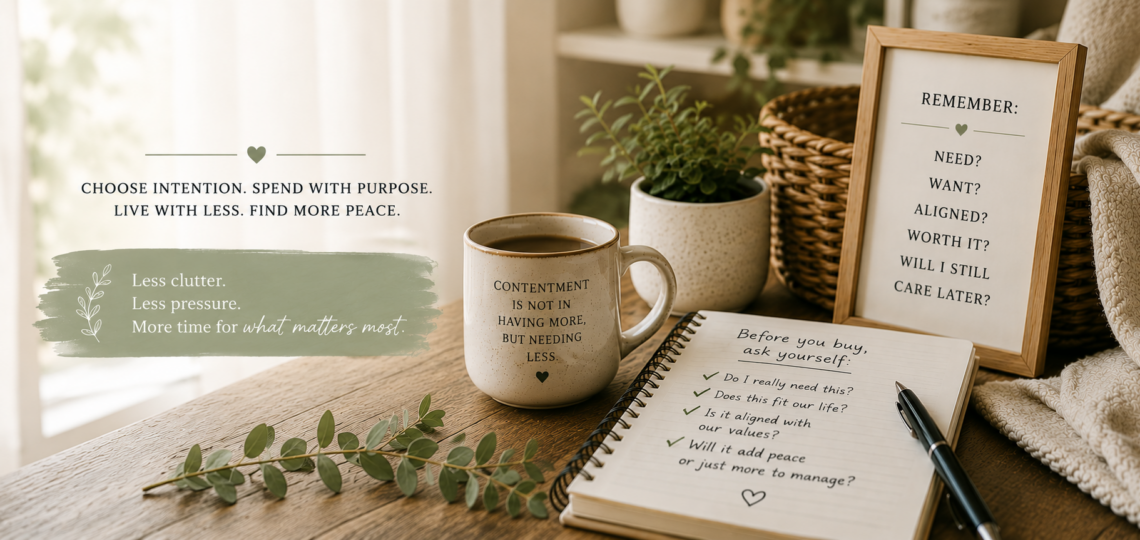
- Does this fit our actual life?
- Will this truly make life easier?
- Is this aligned with our values?
- Do we already own something that serves this purpose?
- Are we solving a real problem or an emotional one?
- Is this a need, a want, or an impulse?
- Will we still care about this in six months?
Those questions alone can save enormous amounts of money and stress.
Not Every “Must-Have” Is Necessary
Many trends are simply cycles of repackaged consumerism.
A product becomes popular online, people rush to buy it, content creators repeat it endlessly, and suddenly it feels essential.
Then six months later, everyone moves on to the next thing.
This happens with:
- clothing
- beauty products
- water bottles
- planners
- cleaning products
- home organizers
- kitchen gadgets
- decor
- wellness items
- subscriptions
- “productivity” tools
Some items truly are useful.
Many are not.
And sometimes the biggest scam is convincing people that ordinary life requires constant upgrading.
Intentional Spending Changes the Atmosphere of a Home
Intentional spending is not about deprivation.
It is about alignment.
It means spending in ways that support:
- your priorities
- your season of life
- your financial goals
- your household rhythms
- your actual needs
It means slowing down long enough to decide rather than react emotionally in the moment.
That might look like:
- waiting a few days before purchasing
- creating a household budget with purpose
- reducing impulse shopping
- avoiding trend-based spending
- borrowing before buying
- repairing instead of replacing
- choosing quality over quantity
- buying less, but using what we own well
Simple living is not about never buying anything.
It is about removing the pressure to constantly consume.
A More Peaceful Home Often Starts with “Enough”
There is a quiet kind of freedom that comes from realizing:
we do not need to participate in every trend.
We do not need matching bins from social media.
We do not need a new aesthetic every season.
We do not need a cabinet full of specialized products for every possible task.
Most homes function beautifully with:
- simple systems
- practical routines
- thoughtful purchases
- contentment
- and far less than modern culture tells us we need
A simpler home creates room for deeper things:
- conversation
- rest
- creativity
- hospitality
- meaningful work
- financial breathing room
- gratitude
And perhaps most importantly, it allows us to build lives centered around values instead of algorithms.